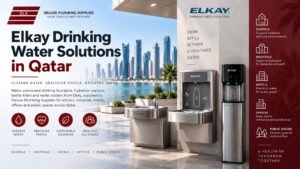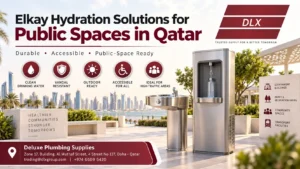
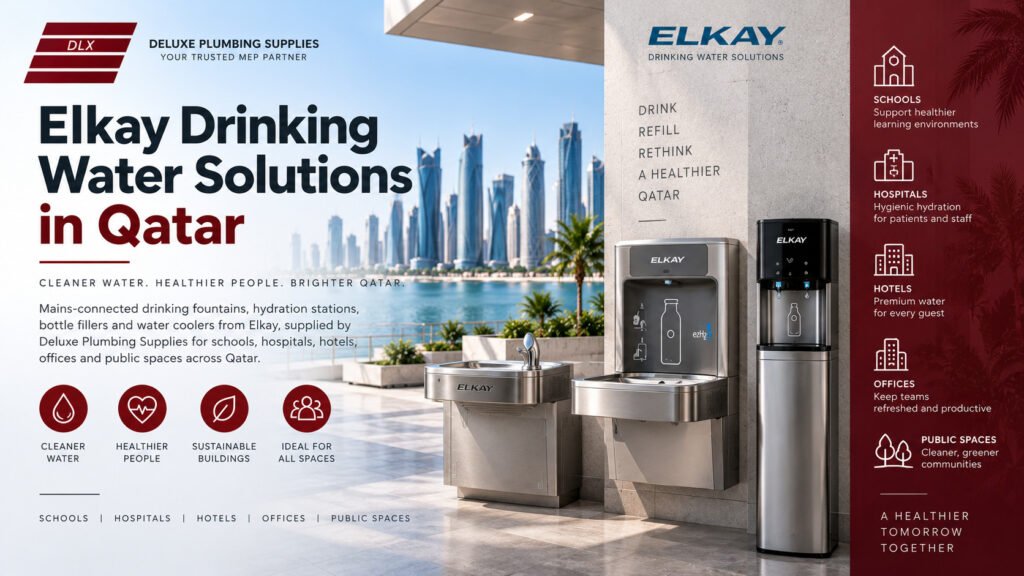
Elkay drinking water Qatar solutions are mains-connected drinking fountains, hydration stations, bottle fillers and chilled water coolers from Elkay that give building occupants clean, cool water on tap, without bottled water deliveries. In Qatar they are specified for schools, hospitals, hotels, offices and public spaces, where the units have to cope with heavy use, high ambient heat and strict hygiene expectations.
This page looks at drinking water from the building’s point of view rather than the product catalogue. It covers the types of drinking water points available, how many a building usually needs, where to place them, how Qatar’s water supply and climate affect the choice, and how the approach changes between a school, a hospital, a hotel, an office tower and a public park. For the brand background and the full list of product families, see our main Elkay Qatar products and hydration guide.
A good drinking water plan is not just a count of fountains. The right mix depends on who uses the building, how long they stay, whether they carry bottles, how hot the incoming water gets in summer and how the facility team will maintain the units. Get those decisions right early and the product choice becomes straightforward. Deluxe Plumbing Supplies helps project teams in Qatar work through them and supplies the Elkay units that fit.
Types of Drinking Water Points in an Elkay Solution
Every Elkay drinking water plan is built from a small set of point types. Each one serves a different habit: drinking on the spot, filling a bottle to carry away, or filling a cup or jug in a pantry. Most buildings in Qatar need at least two of these working together.
Drinking Fountains
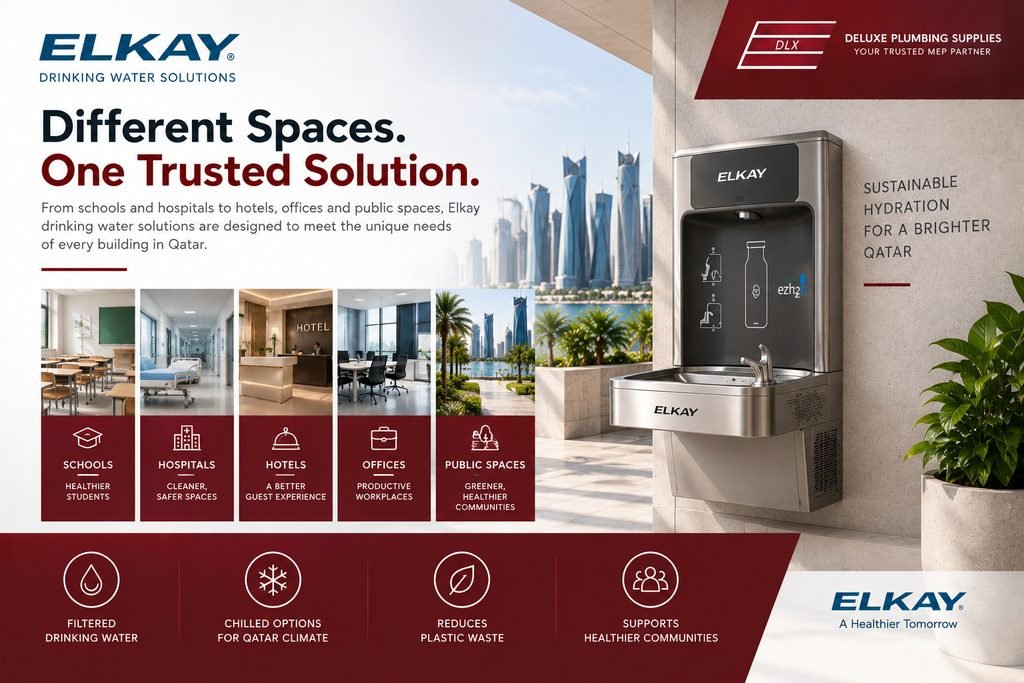
A drinking fountain delivers an arc of water from a bubbler so a person can drink directly from the stream. It is the oldest and simplest drinking water point, and it is still the one most building codes count when they set a minimum number of fixtures. Elkay fountains come in wall-mounted, pedestal, single-level and bi-level formats, with chilled and non-chilled versions.
Fountains suit places where people want a quick drink between activities: corridors, sports areas, entrances and waiting zones. For a full breakdown of the formats, activation options and chilling choices, see our guide to Elkay drinking fountains in Qatar.
Hydration Stations
A hydration station combines a bottle filler with one or two fountain bowls in a single unit, so the same wall position serves people who drink on the spot and people who refill a bottle. Most stations use a sensor to start the bottle filler and shut it off automatically after about 20 seconds, which keeps the flow hygienic and stops water running to waste.
This is now the most common drinking water point on new commercial projects, because it covers two habits in one wall space and one set of connections. Configurations, fill rates and where a hydration station earns its place over a plain fountain are covered in detail on our page about Elkay hydration stations in Qatar.
Commercial-Grade Fountains for Projects
On larger developments, drinking water points are part of the MEP package and have to go through consultant approval, submittals and coordination with civil works. Commercial-grade Elkay units are built for that environment: stainless steel construction, in-wall carriers for recessed installation, vandal-resistant parts and export electrical ratings for Qatar’s 240V, 50Hz supply.
If you are specifying fountains for a tender, a fit-out or a government project, our page on commercial Elkay drinking fountains for Qatar projects explains how project-grade units differ and what the approval documents need to show.
Pantry and Back-of-House Water Points
Not every drinking water point is a fountain. In staff kitchens, meeting floors and hotel back-of-house areas, people fill cups and jugs rather than drink from a bowl. Mains-fed dispensers and cup-fill points handle that role, and they replace bottled water deliveries at the same time.
How the Point Types Compare
| Point type | How people use it | Best locations | Chilled | Filtered option | Counts towards fixture minimums |
| Drinking fountain | Drink directly from the stream | Corridors, sports areas, entrances | Yes or no | Yes | Yes |
| Bi-level fountain | Two heights for standing and seated users | Public corridors, schools, healthcare | Yes or no | Yes | Yes, covers high and low requirement |
| Hydration station | Drink or refill a bottle | Lobbies, gyms, busy corridors | Yes or no | Yes | Fountain part yes; filler usually partial |
| Outdoor fountain | Drink in open areas | Parks, playgrounds, corniches | Limited | Some models | Depends on local authority |
| Pantry dispenser | Fill cups and jugs | Staff kitchens, meeting floors | Usually yes | Yes | Often only as a partial substitute |
The last column matters more than most people expect. Under the International Plumbing Code, which many consultants use as a reference, bottle fillers and water dispensers can usually replace only part of the required number of drinking fountains, not all of them. The final rule for any Qatar project is whatever the approving authority and the project specification require, so confirm it before you swap fountains for fillers.
Planning Drinking Water for a Building in Qatar
Planning starts with three questions: how many drinking water points, where they go, and what each one needs to deliver. Answer those in order and the product shortlist mostly writes itself.
How Many Drinking Water Points Does a Building Need?
The starting figure comes from the occupant load and the building’s use. Many consultants in Qatar refer to the International Plumbing Code for this, alongside the Qatar Construction Specifications and the project’s own brief. The ratios below are the IPC reference values most often used as a baseline.
| Building use (IPC occupancy) | Reference ratio for drinking fountains | What it means in practice |
| Offices and business buildings | 1 per 100 occupants | A floor of 250 people needs at least 3 points |
| Schools and educational buildings | 1 per 100 occupants | Usually at least one point per floor or wing |
| Hospitals and care facilities | 1 per 100 occupants | Plus points in waiting areas and staff zones |
| Retail and malls | 1 per 1,000 occupants | Low ratio, so placement matters more than count |
| Assembly spaces (halls, venues) | Typically 1 per 500 to 1 per 1,000 | Peaks at events can far exceed the minimum |
Two other rules shape the count. First, accessibility: where fountains are required, the minimum is usually a pair, one high for standing users and one low for wheelchair users, which is why a bi-level unit is so common. Second, substitution: the IPC generally allows bottle fillers or water dispensers to replace up to 50 percent of the required fountains, not the full number.
Treat these figures as a floor, not a target. In Qatar’s climate, people drink more water through the day, and a building that only meets the minimum often ends up with queues at break times.
Where to Place Drinking Water Points
Placement decides whether a unit gets used or ignored. A few principles hold across most building types:
- Put them on the natural route. Corridors near lifts, stair cores and main entrances get far more use than a unit tucked into a side lobby.
- Keep them close to activity. Sports halls, gyms, canteens and waiting areas generate the highest demand, so a unit within a short walk of each is worth more than an extra unit on a quiet floor.
- Keep them out of washrooms. Most codes prohibit drinking water points inside public toilets, and users avoid them anyway. Place them in the corridor outside instead.
- Allow for the wall. Recessed units need an alcove and an in-wall carrier. A surface-mounted high bowl in an open corridor can become a protruding object for visually impaired users unless it is set in an alcove or fitted with a guard.
- Plan for power and drainage early. Chilled units need a power point, and every fountain needs a drain connection. Adding either after the walls are closed is expensive.
Qatar’s Water Supply and What It Means at the Tap
Almost all of Qatar’s drinking water is produced by desalination and distributed by Kahramaa, which reports that its supply meets World Health Organization drinking water guidelines and reaches the entire population through its network. The water leaving the network is not usually the problem.
The risk sits inside the building. Rooftop storage tanks, long horizontal pipe runs and low-use branches allow water to warm up, pick up sediment and lose residual chlorine. By the time it reaches a drinking point on the 20th floor, it can taste flat or metallic, and its temperature in summer can be well above what anyone wants to drink.
That is where the choice of unit makes a real difference. A filtered Elkay unit reduces chlorine taste and odour, lead and fine particulates at the point of use, and a refrigerated unit brings the water back down to a drinkable temperature. Filter compatibility, change intervals and certifications are covered on our dedicated Elkay filter replacement page.
Heat, Chilling and Capacity
In most Qatar buildings, a chilled drinking water point is the expectation rather than an upgrade. Incoming water in summer can easily reach 35°C or more in exposed pipework, and an unchilled fountain at that temperature simply goes unused.
Chilling capacity is quoted in gallons per hour. An 8 gallon per hour Elkay cooler produces around 30 litres of chilled water an hour, enough for a typical office floor or school corridor. High-traffic points, such as those near sports halls or in stadium concourses, need higher capacity or more units sharing the load. Size with some headroom, because a compressor running in a hot plant room or a warm corridor works harder than its rated figure suggests.
Elkay Drinking Water Solutions by Sector
The same Elkay units appear across many building types, but the way they are mixed and placed changes a lot from one sector to the next. A hospital cares most about touch points and infection control. A school cares about heights, durability and break-time peaks. A hotel cares about guests never seeing the equipment at all. The summaries below set out the priorities for each sector, and each links to a dedicated page with the full detail.
Schools and Universities
Schools put more pressure on drinking water points than almost any other building. Hundreds of students arrive at the same fountain in a 15-minute break, and many of them are carrying bottles. Units need to be robust, easy to clean and set at heights that suit younger children as well as older students and staff.
The usual approach is bi-level chilled units with a bottle filler in corridors and near classrooms, higher-capacity points beside sports halls and canteens, and outdoor-rated fountains in playgrounds. Several international codes now also push schools towards bottle fillers as part of the required count. Our guide to Elkay drinking fountains for schools in Qatar covers mounting heights, quantities per wing and what to specify for playgrounds.
Hospitals, Clinics and Healthcare Facilities
In healthcare, the drinking water point is part of infection control. Shared push buttons are a contact point that facility teams would rather remove, so sensor-activated units are strongly preferred. Water quality also matters more here, because some patients and visitors are more vulnerable to contaminants than the general public.
A typical healthcare plan uses touchless, filtered bottle fillers in waiting areas and outpatient corridors, with separate points in staff rooms and on wards where the clinical team agrees they are appropriate. For the hygiene features, filter certifications and placement rules specific to clinical settings, see Elkay hydration solutions for healthcare facilities.
Hotels and Hospitality
Hotels have two very different audiences: guests and staff. In guest areas, drinking water points need to look discreet and fit the interior design, which often means recessed in-wall bottle fillers in gyms, spas and pool decks rather than a visible cooler in the lobby. In back-of-house areas, high-capacity units in staff canteens and changing rooms matter far more than appearance.
Many hotels in Qatar are also working to cut single-use plastic bottles, and a well-placed bottle filler is a simple way to support that without affecting the guest experience. Guest-area formats, back-of-house sizing and sustainability angles are covered on our page on Elkay hydration solutions for hotels.
Offices and Commercial Towers
In offices, the drinking water plan usually replaces bottled water deliveries. Once mains-fed units are in place, nobody has to lift 19-litre bottles, find space to store them or wait for the next delivery. The typical layout is a chilled hydration station near the lift lobby on each floor, backed by a dispenser in each pantry.
For multi-tenant towers, the landlord often provides points in common areas while tenants fit out their own pantries, so the drinking water plan has to work at both levels. Floor-by-floor layouts, pantry options and running cost comparisons are explained on our page covering Elkay hydration solutions for offices.
Public Spaces, Parks and Community Facilities
Public spaces are the toughest environment for drinking water equipment. Units sit in direct sun, face dust and sand, and are used by everyone from joggers on a corniche to families in a park. They need outdoor-rated construction, vandal-resistant parts and a drain design that copes with sand.
The usual choice is pedestal or wall-mounted outdoor fountains, with outdoor bottle fillers along walking and cycling tracks. Some Elkay outdoor models add a low bowl for pets, which suits parks and residential communities. Siting, shading and maintenance access in public areas are covered on our page about Elkay hydration solutions for public spaces.
Sector Priorities at a Glance
| Sector | Top priority | Typical Elkay mix | Activation | Filtration |
| Schools and universities | Durability and break-time capacity | Bi-level hydration stations, outdoor fountains | Sensor filler, push-bar bowls | Recommended |
| Healthcare | Hygiene and water quality | Touchless filtered bottle fillers | Fully sensor | Strongly recommended |
| Hotels | Discreet design, staff capacity | In-wall fillers front-of-house, coolers back-of-house | Sensor | Recommended |
| Offices | Replacing bottled water | Floor hydration stations, pantry dispensers | Sensor or push-button | Recommended |
| Public spaces | Outdoor durability | Outdoor pedestal fountains and fillers | Push-button, vandal-resistant | Model dependent |
Drinking Water Specification Checklist for Qatar Projects
Before a drinking water package goes out for pricing or into a submittal, run through the points below. Each one is a common cause of delays, variations or units that underperform after handover.
| Check | What to confirm | Why it matters |
| Occupant load and use | Number of users per floor or zone, and building type | Sets the minimum number of drinking water points |
| Accessibility | High and low bowls, or a bi-level unit, at each required location | Most codes require both heights where fountains are needed |
| Substitution | How many fountains can be replaced by fillers or dispensers | Usually capped at part of the required total |
| Chilling | Chilled or non-chilled, and capacity in litres or gallons per hour | Qatar summer water temperatures make chilling standard indoors |
| Electrical rating | 220V to 240V, 50Hz export models for chilled units | North American 115V models will not run on Qatar’s supply |
| Filtration | Filtered or non-filtered, and the cartridge certification | Protects taste and quality where tanks and long runs are involved |
| Activation | Sensor, push-bar or push-button | Touchless is often required in healthcare and education |
| Indoor or outdoor rating | Correct rating for every location, including shaded outdoor areas | Indoor units fail quickly in sun, dust and sand |
| Mounting and wall build-up | Surface mount, recessed with carrier, or pedestal | Must be coordinated with civil and fit-out drawings |
| Services | Water supply, drain position and power point for each unit | Costly to add after walls are closed |
| Spares and filters | Filters for at least the first 12 to 24 months | Keeps units certified after handover |
Keeping Drinking Water Points Working After Handover
A drinking water point is only as good as its maintenance. Most problems that users complain about, such as poor taste, slow flow or warm water, come from maintenance that has slipped rather than from the unit itself.
A simple routine covers most of it:
- Daily or with each cleaning round: wipe the basin, spout and sensor window, and check that the drain is clear. Sand and debris in outdoor units need extra attention.
- When the filter indicator shows: replace the cartridge. Elkay’s standard bottle filler cartridge is rated for about 11,350 litres or 12 months, whichever comes first, so busy units will need changes more often than once a year.
- Every few months: check the flow rate and the chilled water temperature, and clean the condenser grille on refrigerated units so the compressor is not working against dust.
- Annually: inspect valves, seals and the drain trap, and review whether any location needs a higher-capacity unit based on how it has been used.
For large portfolios, keeping a simple log of filter change dates by location saves a lot of guesswork, and it gives the facility team evidence of water quality management if a client or auditor asks.
How Deluxe Plumbing Supplies Delivers Elkay Drinking Water Solutions
Deluxe Plumbing Supplies is a supplier of Elkay drinking water products in Qatar, based on Al Muthaf Street in Doha. We do not manufacture the equipment. What we do is help contractors, consultants and facility teams turn a drinking water requirement into the right list of Elkay units, then source and deliver them with the documents needed for approval.
A typical enquiry goes through four steps:
- Understand the building. We look at drawings, the occupant numbers and the specification to see how many points are needed and where.
- Match each point to a unit. For every location we confirm fountain, hydration station or dispenser, chilled or non-chilled, filtered or non-filtered, the mounting type and the 240V export version.
- Prepare the quotation and submittals. Pricing comes with the manufacturer’s data sheets so the consultant can review and approve the selection.
- Supply and support. Units are delivered for installation, and replacement filters can be supplied on a planned schedule after handover.
Elkay is one of several plumbing and sanitary brands we supply across Qatar, so drinking water equipment can be sourced alongside the other fixtures on the same project.
Frequently Asked Questions
What are Elkay drinking water solutions?
Elkay drinking water solutions are mains-connected fountains, hydration stations, bottle fillers, water coolers and dispensers that provide clean drinking water in commercial and public buildings. In Qatar they are used in schools, hospitals, hotels, offices and public spaces as an alternative to bottled water.
Is tap water in Qatar safe to use for drinking fountains?
Kahramaa’s desalinated supply is treated to meet World Health Organization drinking water guidelines. Quality can drop inside a building because of storage tanks and long pipe runs, which is why many projects specify filtered, chilled Elkay units at the point of use.
How many drinking fountains does a building need?
The number depends on occupant load and building use. Under the International Plumbing Code, often used as a reference, offices, schools and hospitals need at least one per 100 occupants, while retail needs one per 1,000. The approving authority and project specification set the final requirement in Qatar.
What is the difference between a drinking fountain and a hydration station?
A drinking fountain lets people drink directly from a stream of water. A hydration station combines a bottle filler with one or two fountain bowls, so the same unit serves people drinking on the spot and people refilling a bottle.
Can bottle filling stations replace drinking fountains completely?
Usually not. The International Plumbing Code generally allows bottle fillers or water dispensers to replace up to 50 percent of the required drinking fountains. Most buildings therefore use hydration stations that include both a fountain and a bottle filler.
Do drinking water units in Qatar need to be chilled?
For most indoor public areas, yes. Incoming water in summer can be too warm to drink comfortably, so refrigerated units are the normal choice. Non-chilled units are used where water is cooled centrally or beside an existing chilled point.
Which Elkay units are best for hospitals?
Touchless, filtered bottle fillers are the usual choice for healthcare, because they remove shared contact points and add point-of-use filtration. Placement in waiting areas, outpatient corridors and staff zones is agreed with the clinical and infection control teams.
How often do Elkay drinking water units need servicing?
Basins and sensors should be cleaned daily, filters changed when the indicator shows or at least every 12 months, and refrigerated units checked every few months for flow, temperature and condenser cleanliness. Busy locations may need more frequent filter changes.
Plan Your Elkay Drinking Water Solution in Qatar
If you are planning drinking water for a school, hospital, hotel, office or public space in Qatar, send us your drawings, occupant numbers or the drinking water section of your specification. We will match each location to the right Elkay unit, confirm the 240V export version and filtration options, and return a quotation with the submittal data your consultant needs.
Deluxe Plumbing Supplies
Zone 17, Building 4, Al Muthaf Street, Street No. 137, Doha, Qatar
Email: trading@dlxgroup.com
Phone: +974 6609 6420