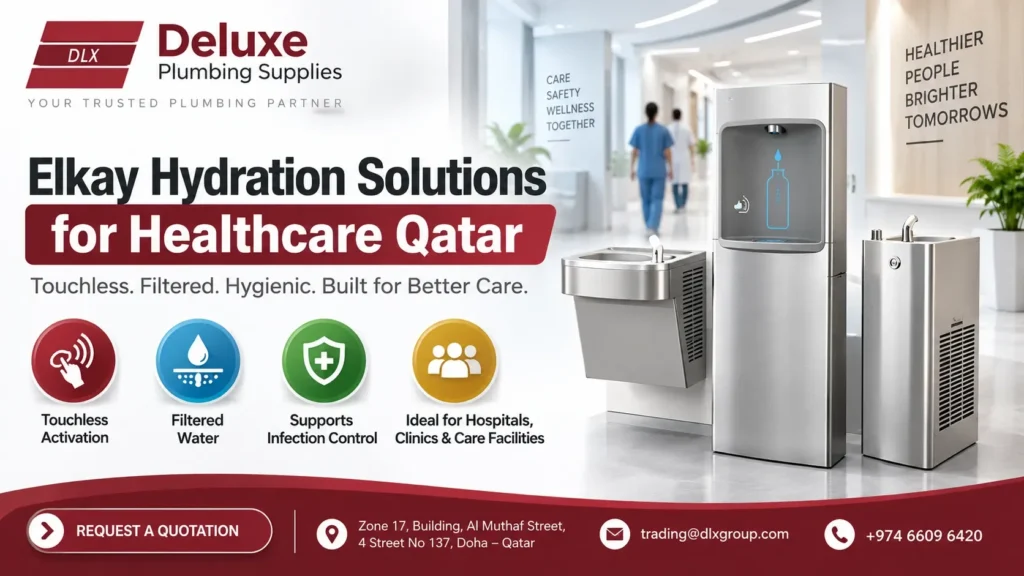
Elkay healthcare Qatar projects — hospitals, clinics, diagnostic centers and long-term care facilities — carry hygiene and infection-control requirements that go beyond what a typical office or retail specification needs to consider. Drinking water equipment in these environments isn’t just a convenience fixture; it’s part of a broader infection-control strategy, which changes how touchless activation, filtration and material choice are evaluated compared with a standard commercial project.
Deluxe Plumbing Supplies is a supplier of Elkay drinking water solutions to healthcare projects across Qatar, working with hospital facilities teams, MEP contractors and consultants to specify hydration equipment that meets the sector’s hygiene expectations without over-specifying features that add cost without clinical benefit.
Why Healthcare Facilities Have Distinct Hydration Requirements
Hospitals and clinics see a mix of patients, visitors and staff moving through shared spaces continuously, often including individuals who are immunocompromised or otherwise more vulnerable to shared-surface contamination than the general public. This context shifts several specification decisions that might be optional elsewhere in a commercial project into near-standard requirements in a healthcare setting.
Touchless Activation as a Baseline, Not an Upgrade
In most other commercial settings, touchless activation is a specification choice weighed against cost. In healthcare facilities, it’s typically treated as a baseline requirement across patient-facing and public areas, given the direct hygiene benefit of eliminating manual contact at a shared fixture. Elkay’s sensor-activated units — covered in detail on our touchless bottle filling station page — are built on the ezH2O platform, pairing sensor activation with a laminar-flow nozzle that also reduces splash-related surface contact around the unit itself.
Filtration in Healthcare Settings
Filtration takes on added weight in healthcare specifications, where water taste, odor and health-related contaminant reduction can matter beyond general occupant comfort. Elkay’s filtered units use WaterSentry® cartridges certified to NSF/ANSI 42 (chlorine, taste and odor) and NSF/ANSI 53 (health-related contaminants, including Class I particulate reduction), giving facilities teams documented certification to reference during infection-control and consultant review. Cartridge capacity and replacement planning are covered on our Elkay filters in Qatar page — a particularly relevant consideration in hospitals, where filter-replacement schedules often need to align with broader facility maintenance protocols rather than being managed ad hoc.
Antimicrobial Material Properties
Many current Elkay units incorporate silver ion antimicrobial protection in key plastic components, helping inhibit mold and mildew growth within the equipment itself — a feature separate from water filtration but relevant to overall unit hygiene in a healthcare context. This is worth confirming explicitly on technical documentation submitted for infection-control review, since it addresses surface hygiene on the unit rather than water treatment.
Product Types Commonly Specified in Healthcare Projects
Waiting Areas and Public Corridors
High-traffic public zones typically call for touchless, filtered bottle filling stations, prioritizing both hygiene and fast throughput given the volume of patients and visitors passing through. Full configuration options are covered on our bottle filling stations in Qatar page.
Patient Floors and Wards
Patient-facing floors often specify a combination of coolers and dispensers depending on the ward layout, with touchless activation carried through consistently. Where a lower architectural profile is needed near patient rooms, in-wall dispensers are worth evaluating — detailed on our Elkay water dispenser page.
Staff Areas
Staff rooms and administrative zones generally see lower-intensity usage and may not require the same filtration or touchless specification applied to public and patient-facing areas, allowing facilities teams to manage cost by differentiating specifications by zone rather than applying the highest standard everywhere.
Outdoor Courtyards and Entrances
Where a healthcare campus includes outdoor waiting areas or entrance courtyards, manufacturer-rated outdoor equipment is required rather than an indoor unit adapted for exterior use — covered on our outdoor drinking fountains page.
Vandal Resistance in Healthcare Settings
Public and semi-supervised areas within hospitals — waiting rooms, corridors, entrance zones — can see similar wear patterns to other high-traffic public buildings. Vandal-resistant configurations, featuring reinforced bubbler guards, are worth evaluating for these zones specifically, even though they’re less relevant in controlled patient or staff areas.
Specifications to Confirm Before Ordering for Healthcare Projects
| Specification | Why It Matters |
| Touchless activation | Near-standard requirement across patient-facing areas |
| Filtration and NSF/ANSI certification | Supports infection-control documentation |
| Antimicrobial material properties | Relevant to unit-surface hygiene, separate from water filtration |
| Zone-specific specification | Public/patient areas vs. staff areas may differ |
| Electrical supply | Current Middle East units are typically 220V/50Hz |
| Outdoor manufacturer rating | Required for any exterior courtyard or entrance installation |
Documentation for Healthcare Consultant Approval
Healthcare projects typically require more rigorous documentation review than standard commercial buildings, given infection-control committee involvement alongside standard MEP and consultant sign-off. Having spec sheets, NSF/ANSI certification documents, BIM/Revit and CAD files, and antimicrobial material data ready in advance helps avoid delays during this review stage.
Sourcing Elkay Hydration Solutions for Healthcare Through Deluxe Plumbing Supplies
As a supplier of Elkay drinking water equipment, Deluxe Plumbing Supplies supports Qatar hospitals, clinics and healthcare developers with:
- Specifying touchless, filtered units for public and patient-facing zones
- Providing NSF/ANSI certification and antimicrobial material documentation for infection-control review
- Sourcing current 220V/50Hz Middle East-spec units
- Differentiating specifications by zone to manage cost without compromising hygiene priorities
- Supporting multi-building and phased hospital project quotations
Frequently Asked Questions
Why is touchless activation more important in healthcare facilities than other buildings?
Hospitals and clinics serve patients and visitors who may be more vulnerable to shared-surface contamination, making elimination of manual contact at hydration points a hygiene priority rather than an optional upgrade.
Do healthcare facilities need filtered water at every hydration point?
Not necessarily everywhere, but filtration is more commonly specified in patient-facing and public areas given the sector’s hygiene sensitivity, while staff-only zones may use a lower specification.
What does antimicrobial protection on an Elkay unit actually do?
Silver ion antimicrobial protection in key plastic components helps inhibit mold and mildew growth on the unit’s surfaces — it’s separate from water filtration, which treats the water itself.
Are outdoor hydration points needed for hospital courtyards?
Yes, where a healthcare campus includes outdoor waiting or entrance areas, manufacturer-rated outdoor equipment is required rather than an indoor unit adapted for outdoor use.
What documentation is typically needed for hospital consultant approval?
Spec sheets, NSF/ANSI filtration certification, antimicrobial material data, and BIM/Revit or CAD files are commonly required to support both MEP coordination and infection-control review.
Request an Elkay Healthcare Hydration Quotation
Send Deluxe Plumbing Supplies your healthcare project details — zones, filtration priorities and expected quantities — and we’ll help specify the right Elkay hydration equipment for your Qatar facility.