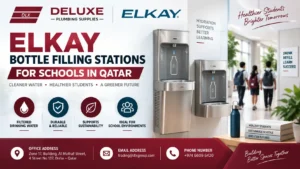
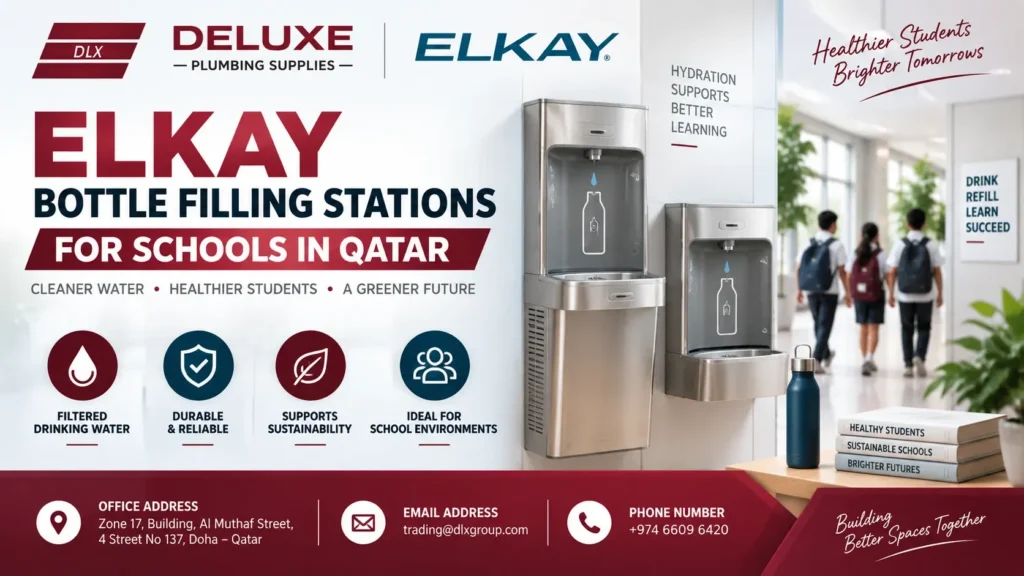
Schools need reliable access to drinking water that is convenient, hygienic and suitable for busy environments. Elkay bottle filling stations provide a practical way to support student and staff hydration while encouraging the use of reusable bottles. Elkay’s education range includes bottle filling stations, filtration solutions, touchless options and indoor and outdoor products designed for educational environments.
For schools in Qatar, the right hydration system should also fit the building layout, expected usage, maintenance plan and project requirements. This guide explains what Elkay bottle filling stations offer, which features matter most, where they can be installed and what schools should consider before choosing a system through Deluxe Plumbing Supplies.
What Are Elkay Bottle Filling Stations for Schools?
Elkay bottle filling stations are commercial drinking-water fixtures designed to make it easier for users to refill reusable bottles. Depending on the model, they can provide filtered or unfiltered water, chilled or ambient water, touchless operation, wall-mounted installation or outdoor use.
In a school, a bottle filling station can be installed in areas such as hallways, sports facilities, cafeterias and other high-use locations. Elkay specifically positions its education solutions for schools and includes options designed for different installation and usage requirements.
The main purpose is simple: give students and staff convenient access to drinking water while supporting reusable bottle use. Elkay bottle filling stations are commercial hydration fixtures that allow students and staff to refill reusable bottles conveniently. Depending on the model, they may include filtration, touchless activation, refrigeration, accessibility features and vandal-resistant construction.
Why Are Elkay Bottle Filling Stations a Good Choice for Schools in Qatar?
Elkay bottle filling stations can be a strong choice for schools because they combine convenient hydration with commercial-grade options for busy educational environments.
Schools often have large numbers of users moving through the same spaces every day. A suitable bottle filler should therefore be easy to use, durable and simple for facilities teams to maintain.
Key benefits include:
- Convenient hydration: Students can refill reusable bottles during the school day.
- Reduced single-use plastic: Refillable bottles can reduce dependence on disposable water bottles.
- Touchless options: Applicable models can reduce the number of surfaces users need to touch.
- Filtration options: Filtered models can provide additional contaminant reduction.
- High-traffic durability: Vandal-resistant products are available for demanding environments.
- Flexible installation: Elkay offers wall-mounted, in-wall, freestanding and outdoor solutions depending on the product range.
- Accessibility: Certain models are designed around accessible installation requirements.
- Maintenance support: Filter indicators and accessible components can simplify routine servicing on applicable models.
Elkay’s education portfolio describes its school products around health, sustainability and convenience, including lead-reducing filtration, hands-free options, vandal-resistant products and indoor/outdoor solutions.
How Does Filtration Improve School Drinking Water?
Filtration adds another treatment stage at the point where users collect drinking water. However, schools should never assume that every bottle filling station is automatically filtered.
Elkay states that filtered and unfiltered bottle filling stations can look similar, so the exact product specification should always be checked before purchase.
For applicable Elkay filtration systems, the manufacturer states that its filters are tested and certified to NSF/ANSI 42 and 53 for reducing substances including lead, particulates, cysts and chlorine taste and odor.
For school projects, the decision should consider:
- Existing water quality.
- Required filtration performance.
- Filter replacement requirements.
- Maintenance access.
- Expected daily usage.
- Manufacturer certifications for the selected model.
Filtration should therefore be treated as a product-selection decision rather than a universal feature.
Which Elkay Bottle Filling Station Features Matter Most in Schools?
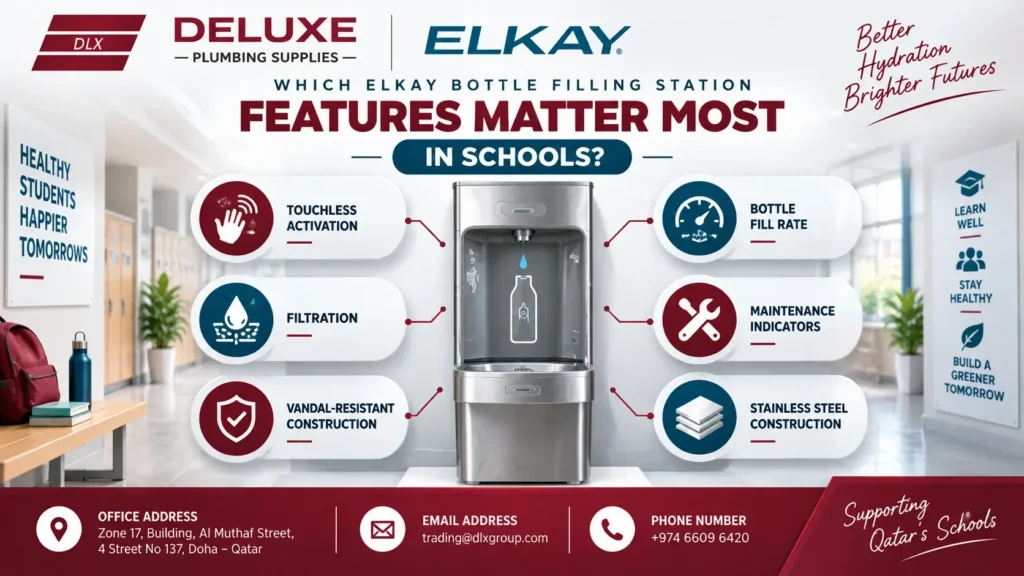
Choosing an Elkay bottle filling station for a school requires more than looking at the design. Schools should consider how often the unit will be used, where it will be installed, and how easily it can be cleaned and maintained. The right features can improve convenience, hygiene, durability, and everyday user experience.
Touchless Activation
Touchless activation can help reduce physical contact when students and staff refill bottles. This feature can be especially useful in busy hallways, sports facilities, cafeterias, and other areas where many users share the same hydration station. Schools should check the activation method of the specific Elkay model before selection.
Filtration
Filtration can provide an additional stage of water treatment at the point of use. For schools that require filtered drinking water, it is important to confirm whether the selected Elkay station includes filtration and what the filter is certified to reduce. Filter specifications can vary between models.
Vandal-Resistant Construction
School hydration stations can experience frequent daily use, particularly in high-traffic areas. Vandal-resistant Elkay options can be considered where additional protection and durability are important. These models may be suitable for locations such as student corridors, recreational facilities, and other demanding environments.
Bottle Fill Rate
A suitable filling speed can help reduce waiting during busy periods. This is particularly relevant during class changes, lunch breaks, and sports activities. Schools should compare the specified flow or fill performance of individual models rather than assuming every station has the same rate.
Maintenance Indicators
Maintenance features can make routine servicing easier for school facility teams. Certain Elkay filtered models include indicators that help show when filter replacement is needed, allowing maintenance staff to plan servicing more effectively.
Stainless Steel Construction
Stainless steel is commonly associated with commercial hydration equipment because it offers a practical finish for frequently used environments. However, construction materials and finishes differ between products, so schools should verify the specifications of the exact Elkay model before purchase.
Which Types of Elkay Bottle Filling Stations Can Schools Choose?
Schools can choose from several installation and configuration approaches.
| Type | Best suited for | Main consideration |
| Wall-mounted | Hallways and indoor common areas | Wall and plumbing access |
| In-wall/recessed | New builds or planned renovations | Requires suitable wall space |
| Surface-mounted | Retrofit projects | Simpler access to an existing wall |
| Bi-level | Shared student environments | Supports different user heights |
| Outdoor | Playgrounds and campuses | Weather and site conditions |
| Vandal-resistant | High-traffic locations | Added durability |
| Filtered | Schools prioritizing point-of-use filtration | Filter maintenance |
| Touchless | Hygiene-focused areas | Power and sensor requirements vary |
Elkay’s current education and facilities information includes on-wall, in-wall and floor-standing solutions, as well as retrofit options.
For a Qatar school project, the correct selection should be based on the building design, expected traffic and installation conditions rather than choosing a product solely by appearance.
Where Can Bottle Filling Stations Be Installed on a School Campus?
Bottle filling stations can be installed in several areas across a school campus to provide convenient access to drinking water throughout the day. The best location depends on student traffic, building layout, plumbing access, and how the space is used. Strategic placement can also help reduce queues and make hydration easier for students, staff, and visitors.
Hallways
Hallways are practical locations for bottle filling stations because students can access them between classes without entering a separate room. Installing a station near busy corridors, entrances, or common areas can make drinking water available during normal movement around the school.
For large schools, multiple hydration points can help distribute demand instead of concentrating students around one station. The available wall space, water connection, drainage, and required clearance should be considered before installation.
Gymnasiums and Sports Areas
Gymnasiums, fitness areas, and sports facilities are natural locations for bottle filling stations because students may need convenient access to drinking water during physical activities. A durable station can support repeated daily use in these high-traffic areas.
Schools can consider placing hydration points near sports halls, changing areas, or other suitable locations where students regularly gather. The station should be selected according to expected usage and the conditions of the installation area.
Outdoor Areas
Outdoor bottle filling stations can provide hydration access around playgrounds, sports fields, and wider school campuses. They can be particularly useful where students spend time outside for sports, recreation, or other activities.
When planning an outdoor installation, schools should consider the selected product’s suitability for outdoor conditions, along with water supply, drainage, mounting, and maintenance access.
Cafeterias
A bottle filling station near a cafeteria can complement the existing water and food-service plumbing infrastructure. This location can provide students and staff with an additional hydration point during meals and busy break periods.
Staff and Administrative Areas
Staff rooms, offices, and administrative areas can also benefit from convenient drinking-water solutions. A filtered bottle filling station may be considered where staff require easy access to drinking water throughout the working day.
Overall, schools should plan hydration points around actual user movement. Distributing bottle filling stations across hallways, sports areas, outdoor spaces, cafeterias, and staff areas can make water access more convenient and help manage demand across the campus.
How Should Schools Choose the Right Elkay Bottle Filling Station?
The right Elkay bottle filling station depends on the school’s location, traffic, water requirements, installation conditions and maintenance strategy.
Before ordering, project teams should review these factors:
- Indoor or outdoor location: Decide where the station will operate and s.elect a product designed for that environment.
- Expected usage: Estimate the number of students and staff who may use the station during peak periods.
- Filtered or unfiltered water: Determine whether point-of-use filtration is required for the project.
- Touchless or mechanical activation: Select the activation method based on hygiene goals, electrical availability and user requirements.
- Wall or floor configuration: Confirm whether the building can accommodate the required mounting arrangement.
- Drainage: Check waste connections and drainage requirements before installation.
- Accessibility: Consider the needs of all students, staff and visitors.
- Durability: High-traffic areas may benefit from vandal-resistant construction.
- Maintenance access: Ensure facilities teams can reach filters, sensors, valves and service components.
- Product specifications: Confirm dimensions, power, flow rate, filtration, mounting and certification for the exact model.
Elkay provides specification, installation and BIM resources for professional users, which can help contractors and project teams coordinate the selected product with the wider building design.
What Should Schools Consider for Installation and Maintenance?
Installation should be planned as part of the school’s complete plumbing system rather than treated as a standalone fixture.
Before installation, contractors should confirm the water supply, waste connection, mounting position, electrical requirements where applicable and available service access. The exact installation requirements depend on the selected Elkay model.
Maintenance is equally important. Schools should establish a routine that includes:
- Cleaning the station and surrounding area.
- Checking for leaks.
- Inspecting drainage.
- Checking sensors or activation controls where applicable.
- Monitoring filter status on filtered models.
- Replacing filters according to the manufacturer’s requirements.
- Checking the fixture after servicing.
- Keeping maintenance records.
Elkay recommends routine cleaning, leak checks, drainage monitoring, filter replacement and verification of operating components as part of school bottle filling station maintenance.
For Qatar projects, facilities teams should also follow the applicable local requirements and the manufacturer’s installation instructions for the exact model.
Why Choose Deluxe Plumbing Supplies for Elkay Solutions in Qatar?
Deluxe Plumbing Supplies can support schools, contractors and project teams looking for commercial plumbing and hydration solutions in Qatar.
The right bottle filling station is not only about selecting a recognizable product. A successful project also requires correct product matching, installation planning and coordination with the building’s plumbing requirements.
When evaluating an Elkay solution, discuss:
- School type and building use.
- Number of expected users.
- Indoor or outdoor location.
- Filtration requirements.
- Touchless requirements.
- Mounting conditions.
- Drainage and water connections.
- Maintenance expectations.
- Required product specifications.
This approach helps schools select a hydration solution based on actual project needs rather than choosing a generic water dispenser.
For related planning, consider linking this page to Deluxe Plumbing Supplies’ commercial plumbing solutions, school plumbing products and water filtration solutions pages using natural anchor text.
What Should Schools Know Before Buying an Elkay Bottle Filling Station?
An Elkay bottle filling station can be a practical school hydration solution, but the best model depends on the project.
Schools should not select a unit based only on the Elkay name or a single feature. Instead, compare the complete specification, including filtration, activation method, installation type, capacity, dimensions, power requirements, drainage, durability and maintenance needs.
It is also important to remember that features vary between Elkay models. Current Elkay products include filtered, non-filtered, touchless, vandal-resistant, indoor, in-wall and outdoor configurations.
Frequently Asked Questions
Are Elkay bottle filling stations suitable for schools?
Yes. Elkay bottle filling stations are designed for environments where people need convenient access to drinking water. Schools can use them in hallways, cafeterias, sports areas, staff spaces, and other high-traffic locations. The appropriate model depends on factors such as expected usage, installation location, filtration requirements, and maintenance needs.
Are Elkay bottle filling stations filtered?
Some Elkay bottle filling stations include built-in filtration, while others are available without filtration. Schools should check the specifications of the exact model before purchasing. For filtered systems, review the filter type, certification, replacement requirements, and contaminants the filter is designed to reduce.
Can Elkay bottle filling stations be installed outdoors?
Yes, Elkay offers bottle filling solutions designed for outdoor applications. These can be considered for playgrounds, sports fields, courtyards, and other campus areas. However, schools should select a model specifically intended for outdoor use and confirm the required plumbing, drainage, mounting, and environmental conditions before installation.
Are touchless Elkay bottle filling stations available?
Yes, Elkay offers touchless hydration solutions for applicable applications. Touchless activation can reduce physical contact when students and staff refill bottles, making it useful in busy school environments. The exact activation method and installation requirements vary by model, so the selected product should be checked carefully.
Where should schools install bottle filling stations?
Common locations include hallways, gymnasiums, sports facilities, cafeterias, outdoor recreation areas, and staff spaces. The best position depends on student movement, water access, drainage, available wall space, and expected demand. Larger campuses may benefit from several strategically placed stations to make hydration access more convenient.
Are Elkay bottle filling stations suitable for high-traffic school areas?
Yes, certain Elkay models are designed for demanding, high-traffic environments. Vandal-resistant options may be appropriate for locations such as student corridors, sports facilities, and shared campus spaces. Schools should compare construction, activation, capacity, and maintenance features when selecting a station for heavy daily use.
Can Deluxe Plumbing Supplies help with Elkay bottle filling station requirements in Qatar?
Deluxe Plumbing Supplies can assist schools, contractors, and project teams in evaluating plumbing and hydration requirements for educational facilities in Qatar. Before selecting a product, it is useful to provide details about the school, installation location, expected usage, filtration needs, and project specifications so the appropriate solution can be considered.