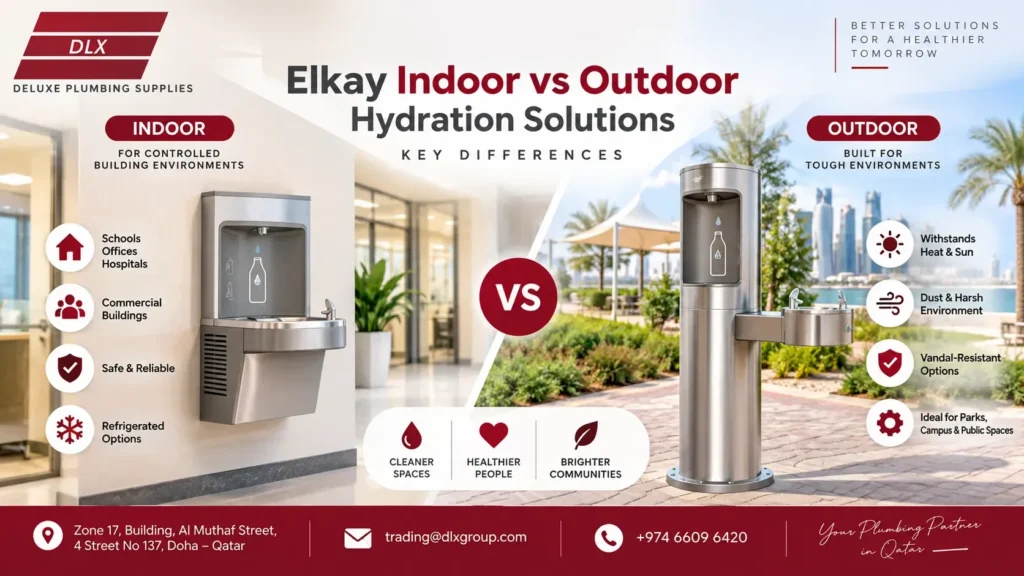
Choosing between Elkay indoor vs outdoor hydration equipment involves much more than deciding where the fixture will be installed.
Outdoor equipment may require different construction, mounting, materials and environmental resistance from indoor bottle filling stations and coolers.
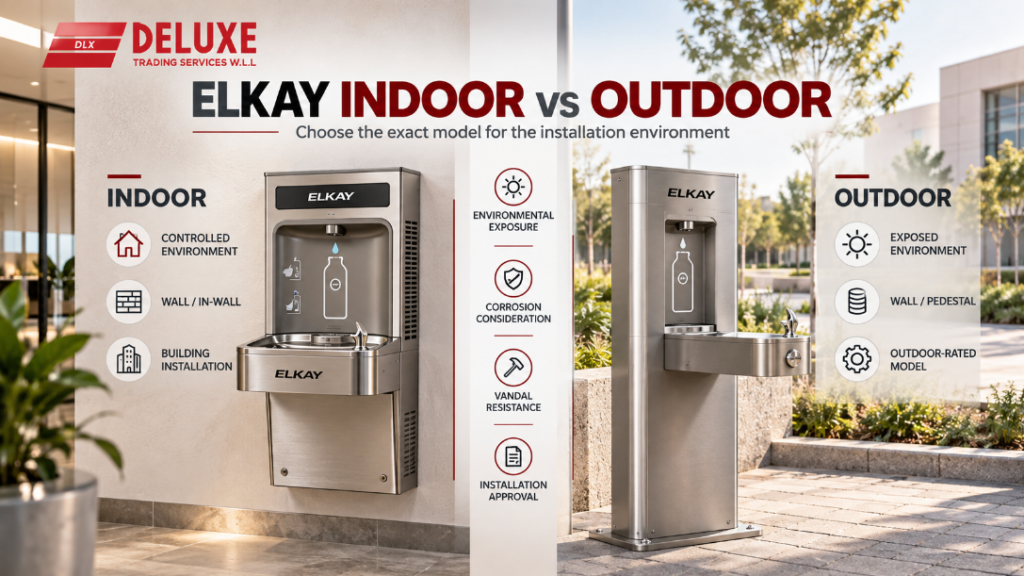
Indoor Elkay systems are designed for controlled building environments, while Elkay’s dedicated outdoor products are designed for exposed applications such as parks, campuses, sports areas and public spaces. Never assume an indoor stainless-steel product is suitable outdoors; verify the exact manufacturer’s installation-location specification.
Indoor vs Outdoor Comparison
| Factor | Indoor | Outdoor |
| Environment | Controlled interior | Exposed environment |
| Typical mounting | Wall/in-wall/surface | Wall/pedestal |
| Environmental exposure | Lower | Higher |
| Corrosion consideration | Standard project requirement | Particularly important |
| Vandal resistance | Model-dependent | Often relevant |
| Refrigeration | Many options | Model-dependent |
| Electrical requirement | Model-dependent | Some require none |
| Installation approval | Exact model | Exact outdoor-rated model |
Indoor Elkay Systems
Elkay’s indoor portfolio includes wall-mounted cooler combinations, in-wall bottle fillers and surface-mounted systems.
For example, LZWSM82K is currently documented as an indoor, filtered, refrigerated in-wall system at 220V/50Hz.
Indoor selection should consider:
Wall construction + water + drainage + electrical + refrigeration + filtration + accessibility + maintenance access
Outdoor Elkay Systems
Elkay offers a dedicated outdoor product family.
Current manufacturer literature describes outdoor tubular products designed for demanding locations such as parks, pools, golf courses, campuses and public spaces.
Selected tubular models use Type 316 stainless steel for increased corrosion resistance.
For example, LK4408BFBLK is manufacturer-designated for outdoor installation and requires no electrical supply.
Why Stainless Steel Alone Is Not Enough
A stainless-steel indoor product should not automatically be treated as outdoor-rated.
Outdoor suitability involves the complete equipment design, components, finishes and manufacturer’s intended installation environment.
The exact model documentation should say Outdoor or otherwise support the proposed installation.
Qatar Outdoor Considerations
For Qatar projects, designers should consider:
- Heat
- Dust
- Direct sun exposure
- Coastal/saline environments where relevant
- Public use
- Cleaning
- Drainage
- Physical impact
- Maintenance access
Product suitability should still be confirmed through manufacturer documentation rather than assumed from Qatar’s climate alone.
Wall-Mounted vs Pedestal Outdoor Systems
Outdoor equipment may be available as wall-mounted or pedestal configurations.
Pedestal systems can be useful where there is no suitable building wall, while wall-mounted products can work where services and structural support are available.
MEP and civil coordination should happen before installation.
Indoor Applications
Common applications include:
Schools, universities, offices, hospitals, hotels, commercial buildings and indoor public facilities.
Outdoor Applications
Potential applications include:
Parks, school grounds, campuses, sports facilities, recreation areas and public spaces.
Frequently Asked Questions
Can I install an indoor Elkay bottle filler outside?
Only if the manufacturer documentation for that exact model permits the proposed installation.
Does Elkay make dedicated outdoor bottle filling stations?
Yes.
Do all outdoor units require electricity?
No. Requirements vary by model.
Are outdoor Elkay products vandal-resistant?
Selected models and configurations offer heavy-duty or vandal-resistant characteristics. Verify the exact product.
Which material is used on Elkay outdoor tubular products?
Current Elkay literature states Type 316 stainless steel is used on its outdoor tubular models.